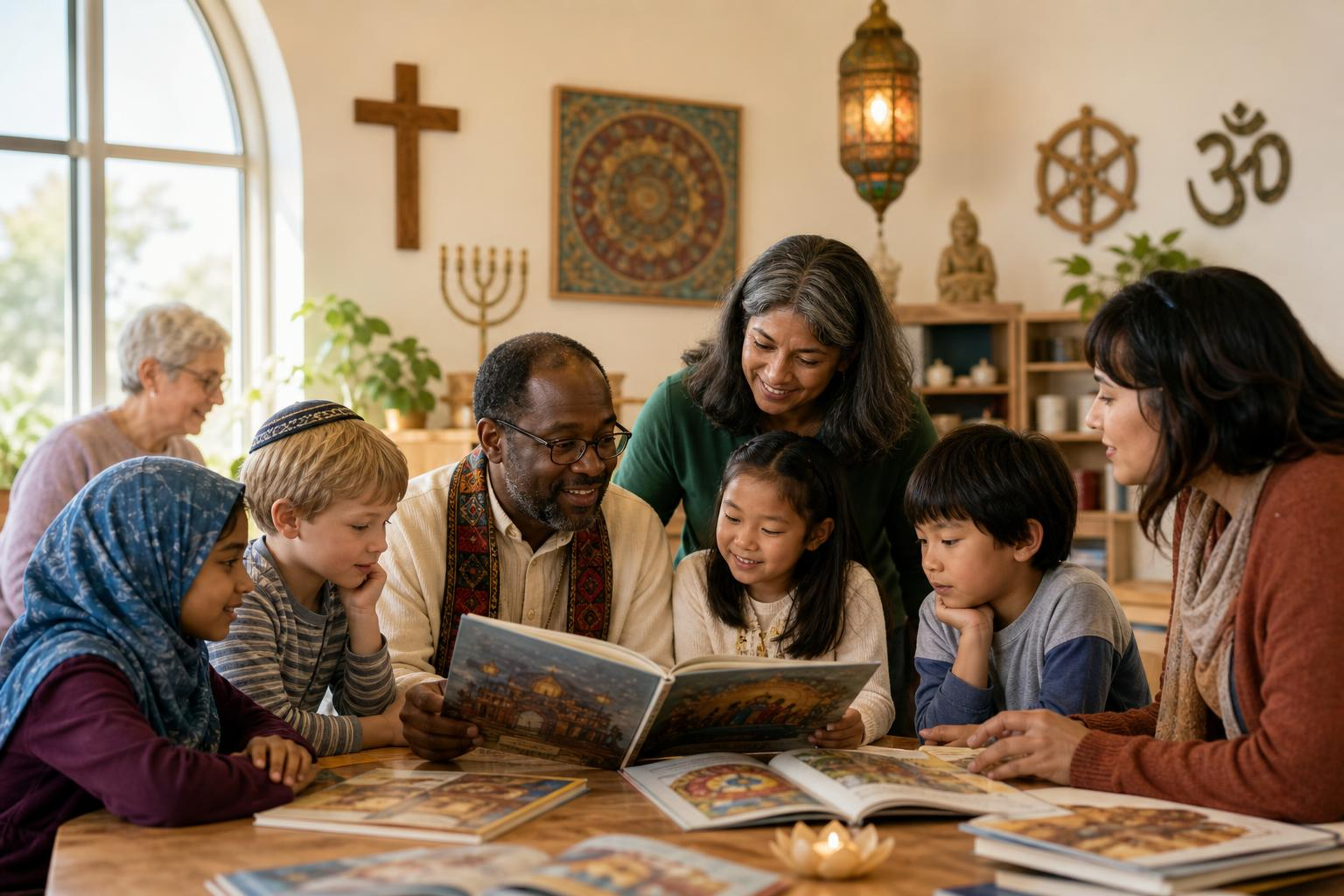
Teaching children religious diversity starts with a simple goal: help them notice differences, ask respectful questions, and treat people of every faith—or no faith—with dignity. You do not need to force belief, and you do not need to know everything. A child learns best when adults model curiosity, kindness, and honesty. This guide gives age-appropriate ideas for books, celebrations, vocabulary, visits, and correcting stereotypes, while keeping the focus on respect rather than persuasion. It also points you to a broader resource on religious understanding: The Pluralism Project, which studies religious diversity and interfaith relations in the United States, and Learning for Justice’s religion resources, which support factual, inclusive teaching about religion.
What it means to teach children religious diversity
To teach children religious diversity means helping them understand that people may pray, celebrate, dress, eat, gather, or describe meaning in different ways. It is not about deciding which faith is right. It is about helping a child recognize difference without fear, mockery, or automatic assumptions. The Pluralism Project describes interfaith and interreligious work as dialogue and cooperation among people of different traditions, while respecting the distinctiveness of each faith tradition rather than blending them into one. (pluralism.org)
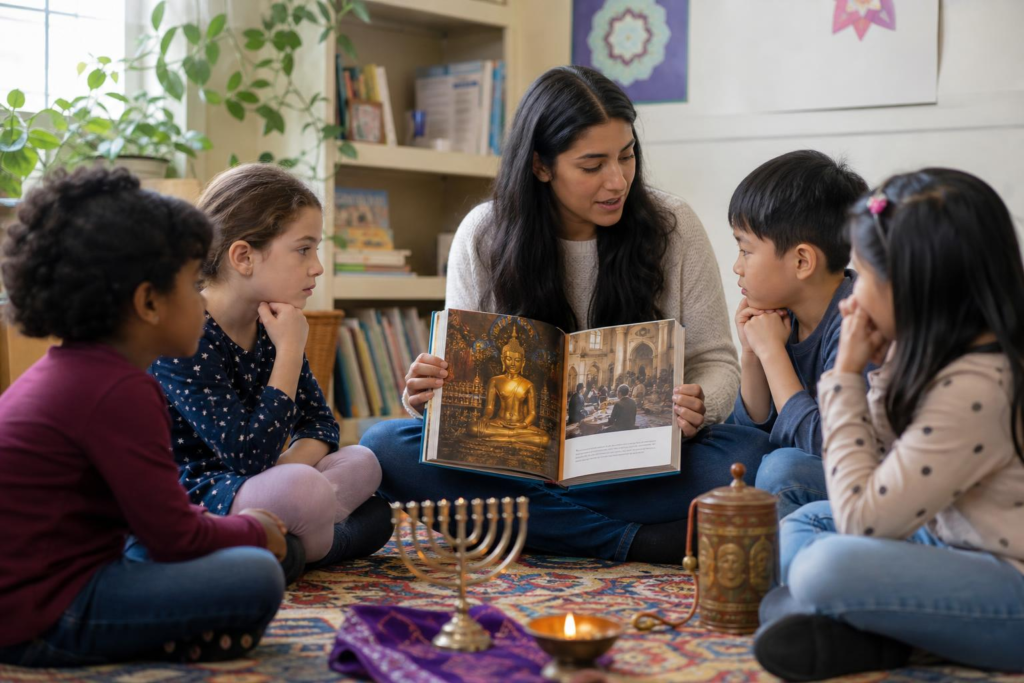
That distinction matters for children. If we teach them that all religions are just the same, we erase real people. If we teach them that one religion is the only normal one, we narrow their world. A healthier path is to say, in plain language, that many communities have sacred stories, practices, and holidays, and that each tradition contains a range of beliefs and practices within it. (pluralism.org)
Teach children religious diversity through everyday language
Children do not need a lecture to begin learning respect. They need a few clear words they can use again and again. Start with vocabulary such as religion, faith, tradition, ceremony, community, worship, sacred, and holiday. For older children, add terms like interfaith, pluralism, denomination, and ritual, and explain that people within the same religion may practice differently. (pluralism.org)
You can also teach simple respectful phrases:
- “What do you celebrate?”
- “How does your family practice?”
- “Is there a word I should use?”
- “Thank you for sharing.”
These phrases work better than making a child perform politeness they do not understand. They also help prevent “spokesperson syndrome,” the problem of asking one person to represent an entire faith group. Learning for Justice specifically warns educators not to treat one family or student as the voice of all people in that tradition. (learningforjustice.org)
For families and churches looking for a broader overview of religious discussion in children’s settings, it can help to pair this article with Learning for Justice’s religion topic page and the Pluralism Project’s resources on dialogue and pluralism. (pluralism.org)
Age-appropriate ways to teach children religious diversity
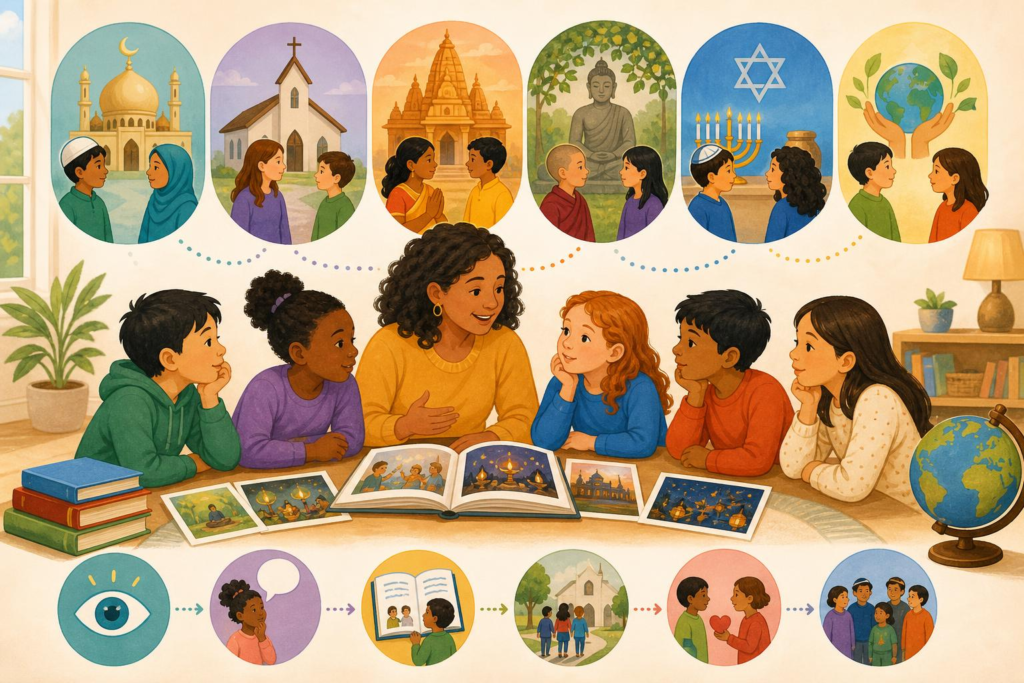
Different ages need different kinds of teaching. The aim is the same, but the depth and detail should grow slowly.
| Age range | Helpful approach | What to avoid |
|---|---|---|
| Preschool to early elementary | Use picture books, family stories, holiday visuals, and simple words like “different” and “respect.” | Abstract comparisons, heavy doctrine, or asking a child to evaluate beliefs. |
| Upper elementary | Introduce maps, symbols, celebrations, places of worship, and vocabulary for questions and comparison. | Oversimplified labels like “all people in that faith do the same thing.” |
| Middle school and older | Discuss internal diversity, stereotypes, discrimination, and respectful conversation across differences. | Debates framed as winning, shaming, or proving one tradition superior. |
For younger children
Choose books with real families, real settings, and respectful images. Interfaith America recommends asking whether a book offers “windows and mirrors,” meaning children can see both their own lives and the lives of others, and whether the story relies on stereotypes. That is a strong standard for any child’s shelf. (interfaithamerica.org)
For school-age children
Try a simple compare-and-notice activity: “What do people wear? Where do they gather? What holidays matter? What words are sacred?” This builds literacy without flattening traditions into costume or trivia. The U.S. Department of Education notes that public schools may teach about religion, but they may not provide religious instruction; they may discuss holidays, history, literature, art, and cultural influence in a neutral way. (ed.gov)
For teens
Teens can handle more honesty. They can learn that religions include multiple branches, that people may be devout, questioning, cultural, or nonreligious, and that identity is not one-size-fits-all. That kind of complexity is not confusion; it is respect. (pluralism.org)
Books, celebrations, and visits that feel respectful
Books and celebrations can help children remember what they learn, but only if they are handled carefully. A child’s goal should be understanding, not performance.
Books
Look for stories that center a child or family within a tradition, rather than turning a religion into a costume parade. Interfaith America’s children’s-book recommendations emphasize books that support religious literacy and interfaith cooperation. You can also use library guides and school resources that distinguish between factual representation and stereotype. (interfaithamerica.org)
Celebrations
It is fine to notice holidays and foods, but be careful not to treat a holy day as a craft project detached from its meaning. The Education Department guidance says schools may celebrate secular aspects of holidays, but not observe holidays as religious events or promote those observances. That guidance is for public schools, but the same common-sense caution helps families too. (ed.gov)
Visits
If your family visits a mosque, synagogue, church, gurdwara, temple, or another sacred space, prepare children ahead of time. Tell them how to dress, whether to remove shoes, how to speak quietly, and who is welcoming them. Better yet, ask the host community what is appropriate. The Pluralism Project’s dialogue resources highlight respectful, local relationship-building as a useful model for learning across faith lines. (pluralism.org)
How to correct stereotypes without creating shame
Children sometimes repeat what they hear at school, online, or from relatives. When that happens, correction works best when it is calm and specific. You are teaching a skill, not picking a fight.
- Name the idea, not the child. Say, “That sounds like a stereotype,” instead of “You are being bad.”
- Offer a true replacement. “Some Muslim women wear hijab, and some do not.” “Some Jews keep kosher, and some do not.” “Some Christians attend church weekly, and some do not.”
- Ask where the idea came from. Often the source is a cartoon, joke, or one-dimensional image.
- Restore dignity. Remind the child that one person never stands for an entire religion or culture.
- Keep learning going. Use a book, map, or local event to widen the picture.
This approach matches research on religious and cultural education that warns against static, outsider-driven descriptions of whole groups. It also fits Learning for Justice’s guidance on communicating with families about religious diversity in a neutral, factual way. (learningforjustice.org)
Planning question: What would it look like for your child to grow up curious instead of fearful about people of other faiths?
Example: You might want a child who can visit a classmate’s celebration, ask polite questions, and know that different beliefs do not make someone strange or unsafe.
Short answer: Curiosity, confidence, and respect.
Simple family activities that build respect over time
Small habits often teach more than big lessons. Try one of these practices and repeat it throughout the year:
- Read one inclusive book each month.
- Notice one holiday from another tradition and learn its meaning.
- Use a world map to place where a tradition began and where it is practiced today.
- Ask a respectful “what, where, and why” question after a visit or story.
- Correct stereotypes gently when they appear in conversation or media.
If your family is faith-rooted, you can also connect these habits to your own commitments: hospitality, neighbor-love, truthfulness, and welcome. Those values make room for difference without diluting conviction. They also let children see that deep faith and generous respect can live together.
How communities can support this work
Families do not have to do this alone. Churches, schools, libraries, ministers, and community groups can help children encounter difference in safe and structured ways. The Pluralism Project provides educational resources on religious literacy and interfaith engagement, and Learning for Justice offers classroom-oriented support for teaching about religion. (pluralism.org)
For communities connected to Ministries of Love, this is one more way to serve people with dignity: by making celebrations, gatherings, and everyday relationships more welcoming to diverse families. If you want practical support, visit get support for next steps. If you want to help others experience more welcoming community life, consider getting involved or making a cash donation if that fits your heart and your means. Those links are best treated as next steps for community care, not as a promise of any specific program or service. (pluralism.org)
Related resources and a helpful next step
If you are also trying to understand how ceremonies, language, and family participation can be handled respectfully across differences, the broader Ministry of Love guides may help. For civil ceremony context, see the civil wedding ceremony guide. For words spoken in meaningful gatherings, see the vows and speeches guide. Even though those guides are about weddings, the same quiet principle applies here: careful language, clear expectations, and respect for people’s real beliefs make a gathering more humane. (pluralism.org)
Conclusion: start small, stay honest, keep the door open
To teach children religious diversity well, you do not need perfection. You need a steady voice, age-appropriate truth, and a willingness to learn alongside your child. Begin with books, vocabulary, respectful questions, and careful corrections. Keep traditions distinct, avoid stereotypes, and never pressure a child to adopt a belief in order to understand it. That is a wise and loving way to raise thoughtful neighbors.
Frequently Asked Questions
How do I teach children religious diversity without pushing a belief?
You can teach it by focusing on understanding, respect, and accurate facts. Use neutral language, show real examples, and let children ask questions without pressuring them to agree with any tradition.
What are good books for teaching kids about different religions?
Good books are respectful, age-appropriate, and written with real detail instead of stereotypes. Look for stories that show how a family lives their faith and whether the book has been recommended by trusted education or interfaith organizations.
How do I explain religious holidays to children?
Start with what the holiday means to the people who celebrate it. Then mention any visible customs, like food or gathering, while being careful not to reduce the holiday to crafts or costumes.
What should I do if my child says something stereotypical about a religion?
Correct it calmly and specifically. Name the stereotype, offer a more accurate fact, and remind your child that no single person represents everyone in a religion or culture.
Can public schools teach about religion?
Yes, public schools may teach about religion in a factual and neutral way. They may not provide religious instruction, but they can cover history, literature, holidays, and religion’s role in culture.
Leave a Reply