

Interfaith friendship does not mean agreeing on everything, and it does not require anyone to become a spokesperson for their religion. It simply means forming a real human relationship across faith differences with respect, patience, and honest curiosity. That kind of friendship grows when people listen well, ask thoughtful questions, and make room for difference without trying to erase it. As the Pluralism Project notes, interfaith efforts are about dialogue, understanding, and cooperation among people of different religious traditions, not creating a new faith. (pluralism.org)
What interfaith friendship really is
At its best, interfaith friendship is a steady relationship between people who may pray differently, worship differently, or not practice religion at all, yet still choose trust, mutual care, and honesty. URI describes interfaith and intercultural dialogue as a way to listen and speak with respect so that understanding and trust can deepen. (uri.org)

That matters because many people carry old assumptions into new relationships. A good friendship makes room for complexity. One person may be deeply observant while another is culturally connected but not devout. One family may keep traditions at home, while another practices in a congregation, temple, mosque, gurdwara, or community center. Treating each person as an individual is not just polite; it is the foundation of trust.
How curiosity builds trust
Curiosity builds trust when it is humble. The goal is not to collect facts about someone’s faith like a checklist. The goal is to understand how that person lives, celebrates, rests, and makes meaning. URI’s community agreements emphasize respectful conversation, privacy, and interrupting hate speech or demeaning language. Those are wise habits for any friendship, not just interfaith ones. (uri.org)
Good curiosity sounds like this: “What helps you feel at home in your community?” “Are there any holidays or practices I should know about?” “Is there a respectful way to ask questions when I am unsure?” Those questions show care without assuming a person represents everyone in their faith.
Question: Are you trying to learn about a friend’s faith, or are you trying to win a debate?
Example: “I want to understand what matters to you, not argue with you. If I ask something clumsy, please tell me.”
Short answer: Curiosity, not competition.
| Helpful habit | What it does | Why it matters |
|---|---|---|
| Ask open questions | Invites a real response | Shows interest without pressure |
| Listen without correcting | Lets the person define themselves | Reduces defensiveness and mistrust |
| Respect privacy | Keeps personal details personal | Builds safety over time |
| Name differences honestly | Acknowledges real boundaries | Prevents fake harmony |
Conversation practices that help friendships last
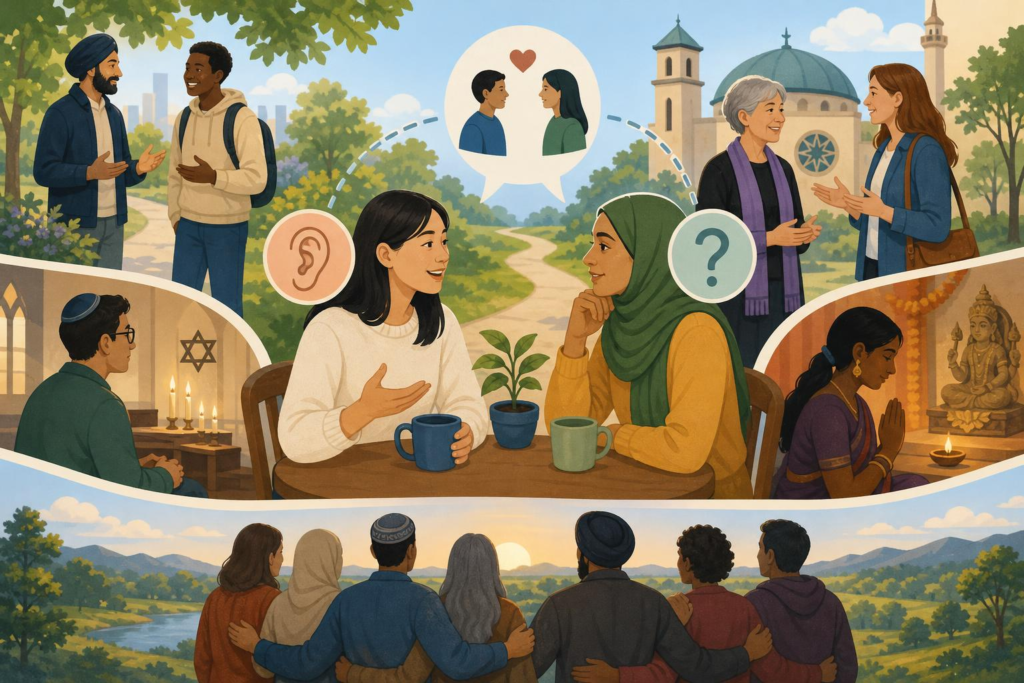
Strong interfaith friendship usually grows through repeatable habits. The first is listening to understand, not to prepare a rebuttal. The second is asking permission before asking personal questions. The third is keeping your language precise, especially when speaking about someone else’s tradition.
1. Ask one sincere question at a time
Simple questions are easier to answer honestly. If you ask too many questions at once, the conversation can start to feel like an interview. One thoughtful question leaves room for the other person to share what they actually want to share.
2. Avoid treating one person as a whole religion
No Jewish person speaks for all Jews. No Muslim speaks for all Muslims. No Christian, Hindu, Buddhist, Sikh, humanist, or any other person speaks for everyone in that group. The Pluralism Project emphasizes the distinctiveness and particularity of each faith tradition, which is a useful reminder that every tradition is internally diverse. (pluralism.org)
3. Reflect back what you heard
Try simple paraphrasing: “So family meal customs are important to you,” or “It sounds like that holiday carries a lot of memory for your household.” Reflection helps the other person feel understood, and it gives them a chance to correct you if needed.
4. Admit what you do not know
It is better to say, “I am not familiar with that practice,” than to pretend expertise. Honest humility is often more respectful than polished confidence.
5. Make room for a gracious exit
Sometimes a person may not want to answer a question. That is normal. Let them pass without making the moment awkward. A friendship becomes safer when both people know that “no” is a complete answer.
What to do when beliefs differ in real life
Respectful interfaith friendship becomes most useful when beliefs meet ordinary life: meals, holidays, weddings, funerals, childcare, and volunteer service. That is where trust gets tested and strengthened.
In shared spaces: Ask what is comfortable before planning food, prayer, music, or seating. A little advance care prevents unnecessary hurt.
In difficult conversations: Focus on the issue, not the identity. You can disagree on theology, ethics, or custom without turning the friendship into a referendum on someone’s worth.
In moments of grief: Offer presence first. People often need steady companionship more than perfect words.
In moments of celebration: Join the joy respectfully. You do not need to practice every tradition to honor it.
Quick friendship check-in
- Have I listened more than I have spoken?
- Have I asked permission before personal questions?
- Have I avoided stereotypes or “all people like this” language?
- Have I respected boundaries around prayer, food, and privacy?
- Have I shown up consistently, not just curiously?
How communities can support interfaith friendship
Friendship across faiths becomes easier when communities make space for it. That can mean interfaith service projects, shared meals, community dialogues, neighborhood cleanups, or learning circles. URI describes its work as bridging religious and cultural differences through cooperation, and its community agreements stress respect, privacy, and solidarity against hate speech. (uri.org)
Faith-rooted ministries, congregations, and community groups can help by hosting gatherings that are welcoming without forcing sameness. That means clear expectations, kind facilitation, and no pressure for anyone to speak as a representative. It also means recognizing that people of no faith belong in the conversation too.
For Ministries of Love, this kind of bridge-building fits a broader calling: helping communities make meaningful celebrations and relationships more accessible through compassionate support, practical guidance, and gentle hospitality. For readers who want a broader introduction to dialogue work, the Pluralism Project’s interfaith resource and URI’s interfaith and intercultural dialogue page are useful starting points. If you are looking for practical community support, you can also explore Get Support or Get Involved.
Planning question: What would help this friendship feel safe and mutual in your setting?
Example: “We could meet over coffee, keep the conversation private, and avoid questions that put anyone on the spot.”
Short answer: Safety, privacy, mutual respect.
Common mistakes to avoid
Even well-meaning people make predictable mistakes when they are learning how to build interfaith friendship. The good news is that most of them are fixable.
Don’t flatten differences. Saying “we all believe the same thing” can sound nice, but it often hides real distinctions that matter deeply to people.
Don’t turn every conversation into a lesson. Friendship is mutual, not a one-way education project.
Don’t use shock questions. If a question is designed to surprise, embarrass, or test, it is not curiosity.
Don’t assume shared values mean shared practices. Two people may both value compassion, for example, while expressing that value in very different ways.
Don’t rush trust. Real confidence takes time. That is not failure; that is how honest relationships work.
A simple next step
If you want to begin well, choose one person, one question, and one act of follow-through. Ask a respectful question, listen carefully, then remember something specific for next time. That is how friendship becomes real.
For readers involved in congregations, ministries, venues, or volunteer networks, this same posture of respectful curiosity can make wedding planning, community outreach, and shared events gentler and more inclusive. If your next step is support for a meaningful celebration, you may also find Wedding Vows and Speeches Guide helpful for language that honors diverse traditions with care.
Frequently Asked Questions
What is interfaith friendship?
Interfaith friendship is a real relationship between people from different religious or nonreligious backgrounds built on respect, curiosity, and trust. It does not require agreement on beliefs.
How do I ask questions without being offensive?
Ask permission, keep your questions specific, and let the other person decline. Start with questions about lived experience rather than doctrine or personal tests.
Do I have to understand someone’s religion to be friends?
No, you do not have to understand everything to be a good friend. You do need humility, patience, and a willingness to learn over time.
What if my friend and I disagree about faith?
You can still be friends if you keep the disagreement respectful and avoid turning every conversation into a debate. Shared trust matters more than perfect agreement.
How can churches or ministries support interfaith friendships?
Churches and ministries can host welcoming conversations, service projects, and shared meals with clear expectations and thoughtful facilitation. They should make space for people of different faiths and no faith without pressure to conform.
Leave a Reply